The Three-Field System
A revolutionary Medieval European crop rotation method that integrated nitrogen-fixing legumes, fundamentally increasing land productivity and fueling a massive population boom.
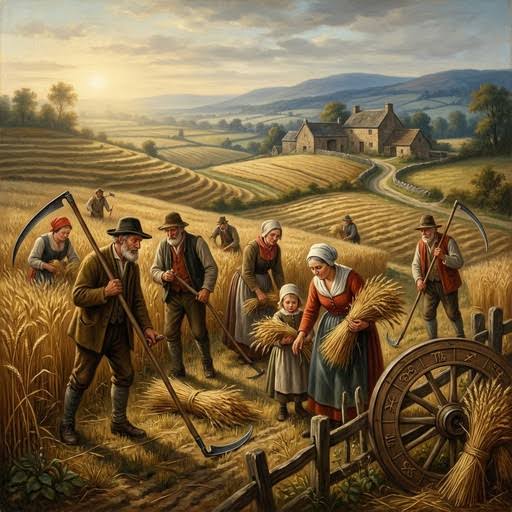
Historical Overview
The Roman Limitation: The Two-Field System
During classical antiquity, the standard method of agriculture across the Mediterranean and Roman domains was the two-field system. In this method, a farmer would plant half of their arable land with winter wheat or rye, leaving the other half completely fallow (unplanted) for an entire year so the soil could recover its nutrients. This meant that, at any given time, only 50% of an estate's land was producing food, placing a hard biological ceiling on population growth.
The Medieval Innovation: The Three-Field Rotation
Emerging around the 8th century CE and spreading rapidly through Northern Europe by the 11th century, the three-field system represented a paradigm shift in agronomic efficiency. The arable land was divided into three distinct zones, rotating annually:
- Field 1 (Autumn Planting): Sown with winter cereals like wheat or rye, establishing deep roots to survive the frost and harvested the following summer.
- Field 2 (Spring Planting): Sown with oats, barley, or most crucially, legumes like peas and beans. This spring crop provided vital animal fodder and dietary protein.
- Field 3 (Fallow): Left unplanted to rest, often used as pasture for livestock whose manure naturally fertilized the soil.
The Chemical Engine: Nitrogen Fixation
The true genius of the three-field system was the introduction of the spring legume crop. Unbeknownst to Medieval farmers, legumes host symbiotic rhizobia bacteria on their roots, which pull atmospheric nitrogen and convert it into bioavailable soil nitrogen. Instead of simply draining the soil, the spring crop actively repaired it. This system increased the actively productive land from 50% to 67%, diversified the peasant diet with high-quality plant proteins, produced enough surplus oats to transition from slow oxen to fast draft horses, and ultimately laid the caloric foundation for the European High Middle Ages.