Andean Terrace Farming (Andenes)
An ancient, highly engineered topographical modification system used by the Inca and pre-Inca civilizations to cultivate crops on steep mountain slopes, maximizing arable land and creating artificial microclimates.
Historical Overview
The Vertical Challenge: Farming the Andes
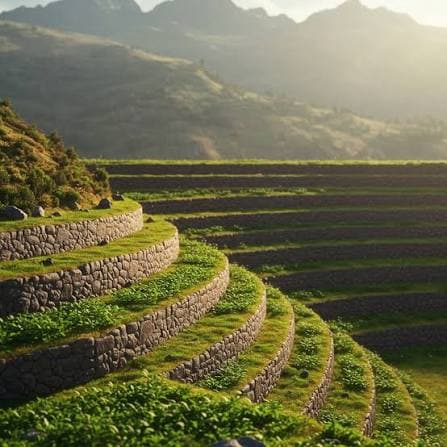
The Andes mountain range presents one of the most hostile agricultural environments on Earth. With slopes often exceeding 45 degrees, extreme diurnal temperature fluctuations, and highly variable precipitation, the establishment of large-scale agriculture seemed geographically impossible. However, to support the dense populations of empires like the Wari and the Inca, indigenous agronomists engineered a monumental solution: the andenes (agricultural terraces).
These stepped terraces transformed impossible gradients into flat, productive ribbons of arable land, fundamentally altering the topography of the South American highlands and allowing for the mass cultivation of potatoes, quinoa, and high-altitude maize.
Engineering the Andenes
Constructing a functional terrace was not merely a matter of moving dirt; it required advanced hydrology and structural engineering. The anatomy of a classic Inca terrace consists of several carefully calibrated layers:
- Retaining Walls: The outer face of the terrace was built using expertly fitted stone masonry, angled slightly inward against the slope to withstand the immense hydrostatic pressure of wet soil and prevent catastrophic landslides.
- The Drainage Base: At the bottom of the terrace bed, engineers laid a thick foundation of large stones and coarse gravel. This was crucial for preventing waterlogging, which would rot crop roots and compromise the structural integrity of the wall.
- Topsoil Translocation: Because high-altitude mountain slopes naturally possess very little fertile soil, the Inca undertook massive logistical operations to transport nutrient-rich topsoil from the valley floors up the mountainsides to fill the terrace beds.
Thermal Mass and Microclimates
Beyond preventing soil erosion and managing water, the andenes served a brilliant thermodynamic function. The stone retaining walls absorbed intense solar radiation during the day. As temperatures plummeted at night, these stones slowly radiated the stored heat back into the soil and surrounding air.
This thermal mass effect created localized artificial microclimates, raising the ambient temperature immediately around the crops just enough to prevent fatal frost damage. By carefully managing the elevation, orientation to the sun, and thermal retention of these terraces, the Inca effectively expanded the geographical limits of cultivation, growing crops at altitudes where they would biologically fail in an open field.