CRISPR-Mediated Climate Resilience in C4 Cereals
Advanced genomic editing utilizing CRISPR-Cas9 to induce drought resistance and thermal tolerance in foundational global crops, redefining food security in the Anthropocene.
Historical Overview
The Legacy Paradigm: The Evolutionary Limits of C4 Photosynthesis
C4 cereals—such as maize (Zea mays), sorghum (Sorghum bicolor), and proso millet—are the backbone of global food security. Evolutionarily, these crops developed specialized leaf anatomy to concentrate carbon dioxide around the Rubisco enzyme, inherently enhancing their photosynthetic and water-use efficiency compared to older C3 plants.
Despite this evolutionary advantage, the Anthropocene brings unprecedented climatic volatility. Under extreme heat and high vapor pressure deficit (VPD), C4 crops are forced into aggressive stomatal closure to prevent fatal water loss. This necessary survival mechanism creates a devastating trade-off: closed stomata halt carbon dioxide diffusion, causing an immediate and catastrophic drop in photosynthesis and crop yield. Traditional selective breeding has proven too slow to adapt these crops to the rapidly accelerating pace of global warming.
The Genomic Shift: Precision Over Transgenics
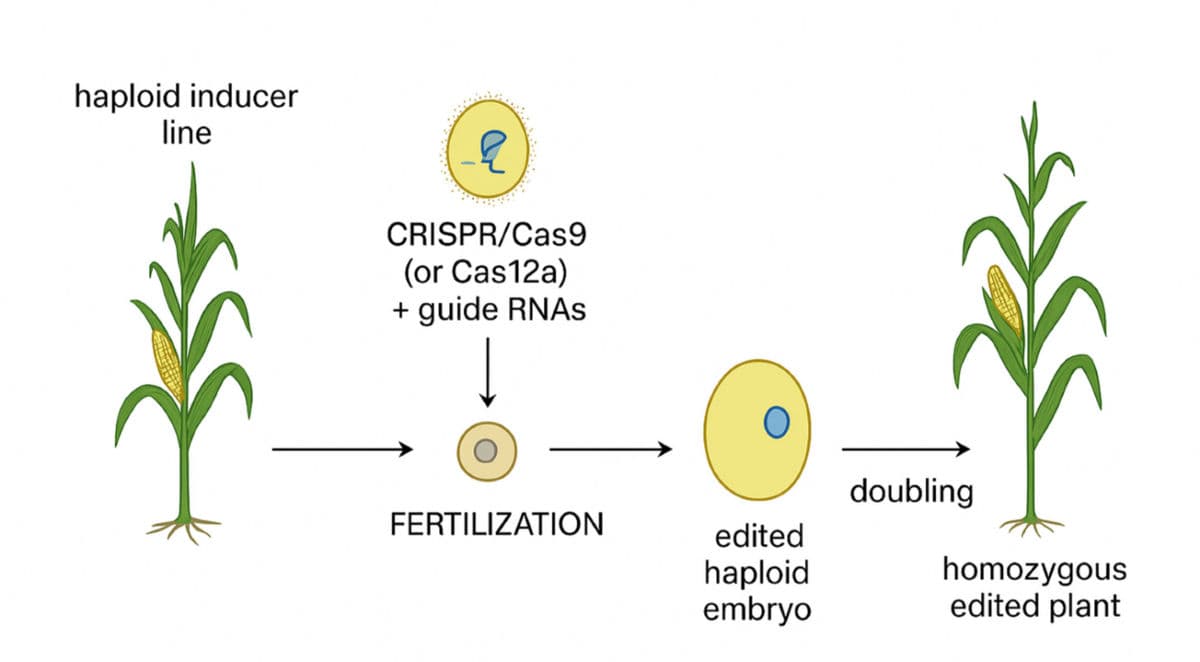
To avert projected yield collapses in tropical and subtropical regions, agricultural science has shifted from conventional transgenics to precise gene-editing technologies. Unlike legacy tools such as Zinc Finger Nucleases (ZFNs) or TALENs, the Clustered Regularly Interspaced Short Palindromic Repeats (CRISPR) and its associated Cas9 endonuclease offer unprecedented accuracy, cost-effectiveness, and speed.
Because CRISPR/Cas9 can induce targeted mutations, gene knockouts, or promoter modifications without introducing foreign DNA, it largely bypasses the intense regulatory hurdles and public skepticism traditionally associated with Genetically Modified Organisms (GMOs). This allows researchers to isolate and permanently edit the exact genetic sequences responsible for climate survivability.
Core Technological Drivers: Rewriting the Drought Response
Current biotechnological breakthroughs focus on the highly complex genetic pathways governing plant-water relations and thermal tolerance. Through multiplexed CRISPR editing, agronomists are targeting several critical mechanisms:
- Promoter Modification of the ARGOS8 Gene: In maize, advanced CRISPR/Cas9 techniques have been successfully utilized to insert a novel promoter into the 5-untranslated region of the ARGOS8 gene. This precise modification significantly improves grain yield under severe drought conditions without penalizing the plant's growth during optimal watering periods.
- Modulating the ABA Signaling Pathway: Abscisic acid (ABA) is the primary plant hormone dictating responses to osmotic stress and drought. By targeting the promoters of ABA-sensitive transcription factors (like AREB1) and specific protein kinases (like SnRK2), CRISPR-edited lines exhibit heightened epigenetic sensitivity to environmental stress. This results in faster, more efficient stomatal regulation and dramatically improved survival rates during extended periods of water scarcity.
- Enhancing Nonstomatal Transpiration: Recent research has revolutionized our understanding of leaf-water dynamics, revealing that C4 crops inherently utilize nonstomatal mechanisms to limit water loss. By maintaining relative humidity within the substomatal cavity down to 80% under stress, edited C4 plants can continue capturing carbon dioxide even when atmospheric demand for water is exceptionally high, directly challenging the assumption that water preservation must always cost carbon intake.
Ecological & Economic Implications in the Anthropocene
The successful deployment of CRISPR-edited C4 cereals carries profound implications for global ecology and economics. With changing climates threatening to reduce African food crop production by nearly 3% by 2050, integrating drought-resilient and heat-tolerant maize and sorghum is no longer optional; it is an existential necessity for global stability.
By achieving up to a 30% yield increase and 25% improved water retention in field trials of edited maize, this technology promises to stabilize volatile food markets. Furthermore, by improving intrinsic water-use efficiency, these crops reduce the immense ecological burden placed on ancient aquifers and modern irrigation infrastructure, paving the way for a truly sustainable, high-yield agricultural future.